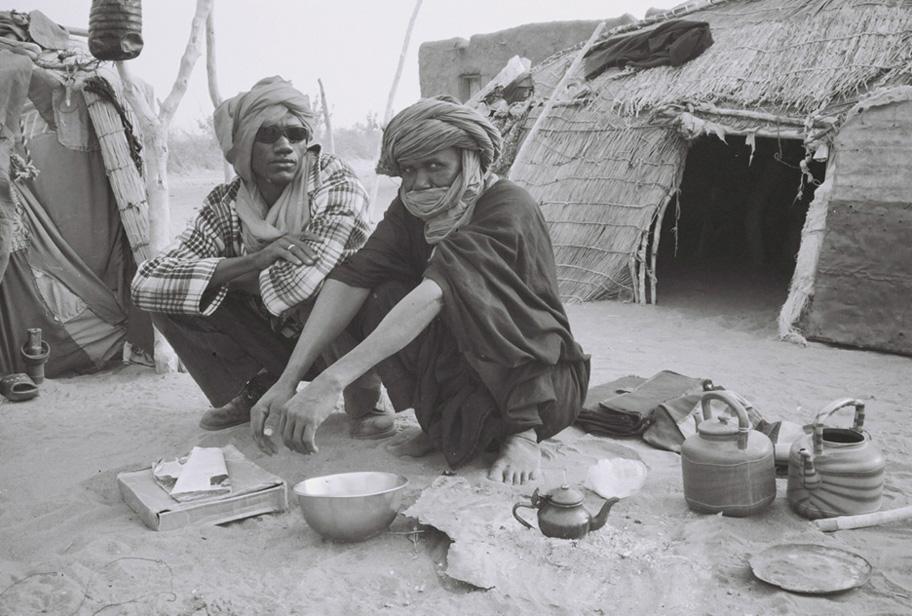
I recently concluded a three month research project in Mauritania. As someone who lived and worked in Mauritania as a Peace Corps volunteer twelve years ago (1999-2001), I noticed the changes as well as the maintenance of some parts of Mauritanian society, both the good and bad. At the risk of imposing my own cultural biases, I present them here to reflect on the good, the bad, the blessings, and the chronic ills that I observed from August to October 2013.
Things that changed in Mauritania … for the Better
(1) Solar
power is expanding. It is obviously present in the recent construction of
cellphone towers, but it is also replacing gasoline-powered motor pumps in the
gardens and is seen powering more and more street lights in urban areas
(observed in the cities of Nouakchott and Akjoujt).
(2) People’s
diets are diversifying. Mauritanians, especially Moor groups who were resistant
in eating foods from outside their communities in the past, are eating more
fruits, vegetables, fish and now even chicken (which was a taboo in Moor society
in the past). However, there is a catch to this. See No. 1 in Things that
changed in Mauritania … for the Worse.
 |
| Peanuts, Fruit of the Baobab and other Wild Fruit (Atâr, Mauritania) |
(3) Mentioned
above but worth elaborating on more is the expansion of fish markets to
remote/peripheral neighborhoods in regional towns and to villages (not all but
the number is growing). Fish with rice is growing as the main meal and if
households have the means the dish includes tomatoes, yam, cabbage, eggplant,
bell pepper, cayenne pepper, and/or lime.
(4) With
the exception of the Tiris Zemmour region which has not seen rain in the past
two years, the rains are more frequent and abundant. During my Peace Corps
experience there were moderate droughts in the Adrar Region. During this recent
research I saw and abundance of rain in the Dakhlet-Nouadhibou, Nouakchott,
Inchiri and Adrar regions. I did not go to the South, Central and Eastern
Regions of Mauritania but from what people told me and what was broadcasted on
television they witnessed record rainfalls.
 |
| Water caught between the rocks (North of Loqsier Terchane, Mauritania) |
(5) The
media has improved by leaps and bounds. Thanks to satellite and dish receivers,
Mauritanians are viewing programs from the Arabian Gulf, Turkey, India and
other parts of North Africa/Middle East. Some of these are dubbed into Arabic;
others have Arabic subtitles. There is a downside to this. See No. 6 in Things
that changed in Mauritania … for the Worse.
(6) Improvements
have come to transportation, although there still is room for improvement here.
Transport from cities between urban areas involves an air-conditioned van. The
Peugeot 504s are almost extinct except for the run between Nouakchott and
Nouadhibou which involves some hard bargaining and patience for an all-day
commitment to travel. There are now also Toyota Hiluxes that travel between
Nouakchott and Zouerât.
(7) Cellphones
are affordable. Every Mauritanian has one or two … or four! The universal
ownership of cellphones put téléboutiques out of business but if one does not
have a phone and needs to make a phone call, generally, anyone on the street
will help. Should the number be the same carrier as the cellphone owner’s service
that makes it much easier (as the cost is low).
(8) Mauritanians
are more rigorous about washing their hands with soap both before and after
their meals. There are public announcements on television that promote this
practice.
Things
that changed in Mauritania … for the Worse
(1) The
cost of food has risen and with it, the dependence on imported foods is
increasing. This is not to say that Mauritania was once a self-sufficient food
producer. It has a heritage, through the Trans-Saharan trade, of importing
foods from the North and the South. But the benefit of people diversifying
their diets (see No. 2 in Things that changed in Mauritania … for the Better)
brings in foods that for some are a luxury and for many unobtainable.
Furthermore, with many people moving to urban environments for better
opportunities, few remain in the countryside to engage in food production. This
cripples local food production while contributing to the dependency on imported
foods.
(2) People
are not as hospitable as they were before to outsiders. A few reasons may be
contributing to this. One, urbanization may have the consequence of unraveling
a sense of community and the norm of welcoming strangers. Two, tourists, aid
workers and other foreigners may have taken advantage of Mauritanian
hospitality one too many times without any effort at reciprocity. Three, the
vilification of Islam in most Western media equating conservative Muslims,
which most Mauritanians are, with terrorism may be diminishing the desire to
interact with foreigners.
(3) The
change in climate, although bringing more water, pasture and cultivatable land
to the countryside, is devastating to urban environments, particularly
Nouakchott’s original neighborhoods of Tefragh Zeina, Ksar, Cinquième and El
Mina that have no sewage and lack topography. The result of more and heavy
rainfall results in stagnant water, damage to electricity poles and cables, not
to mention the increases in mosquito and fly populations. Residents of urban
environments face the risk of electrocution, damage to their homes from
flooding, exposure to molds, and outbreaks of malaria, cholera, and other
diseases transmitted by mosquitoes and flies.
(4) With
a moratorium on tourism because of the scare of terrorism, some working in the
tourist industry have grown more aggressive in landing clients and in
increasing incidents, steal or trick tourists out of their money. This is not
to say that touts did not exist in Mauritania before, but the frequency and
exposure tourists have to hustlers is growing more frequent at places where
tourists arrive, particularly borders and transportation parks. Legitimate tour
operators also suffer from this as they lose clients and tourists who have bad
experiences are unlikely to return to Mauritania.
(5) Processed
foods are starting to replace natural ones. For example, the drink Bissap,
which is sold in all corners of Mauritania, is not necessarily prepared the way
as it was in the past. Before, and admittedly some still continue this practice,
it is prepared by boiling water, adding flowers from the Hibiscus sabdarrifa plant to the boiling water, cooling the
concoction, straining the solid parts out and adding sugar. Today, however,
there are merchants selling Bissap using the same name but actually preparing
powdered fruit drinks like the brand name “Foster Clark.”
 |
| Hibiscus Plant (Oum Labouir, Western Sahara) |
(6) Women
of all Mauritanian groups are using more and more bleaching crèmes on the faces
and the rest of their skin. There is nothing wrong or unattractive about having
a dark complexion but the commercials for beauty products do their best to make
dark complexions seem unnatural and unappealing. They promote their products as
removing blemishes, and more importantly, as ‘fairness treatments.’ The use of
bleaching crèmes by Mauritanian women is probably, sadly, a negative
consequence of the expansion of the media (See No. 5 in Things that have
changed in Mauritania … for the Better).
Things
that did not change in Mauritania … and Shouldn’t
(1) The
absence of spices in cooking. With the exception of Fish with Rice, most
Mauritanian dishes are prepared with Saharan salt (which does not contain
Iodine) or sugar, and, in a few exceptions for a savory dish, pepper. This may
sound repulsive at first but look at the other cuisines around the world that
use a variety of spices, sometimes so many in one dish that one does not know
the true flavor of meat, chicken, fish or vegetables. The minimal use of spices
makes Saharan food unique, and for people visiting Mauritania it is a reminder
of what food tastes like.
(2) Leben
(yoghurt) and Zrig (a curdled milk drink). When I mention these two I do not
mean the powdered or canned milk versions (Relative to No. 5 in Things that
changed in Mauritania … for the Worse). I mean the curdled camel’s or goat’s
milk, and in regards to Zrig, diluted with water and seasoned with sugar.
(3) The
music Moor culture produces. A claim like this should receive some blowback
from my former Peace Corps peers who had to endure agonizing taxi brousse rides
listening to the driver’s love of women wailing and erratic riffs of an
electric guitar. But placing cultural bias aside, it is a unique music, unlike
other genres in the world, and I have listened to this music enough to know
there are talented musicians that convey spirituality through their art form
that moves other Mauritanians.
(4) Mauritania’s
ethnic diversity. Within its borders are White and Black Moors (Bidan and
Haratin respectively), Wolof, Hal Pulaar/Peulh, Soninké (Sarakolé), Bambara,
and a handful of Tuareg (Kel Tamacheq) in the Eastern regions of the country.
Add to this other African groups like Moroccans, Nigerians and Ghanaians in the
large and regional towns and it makes for a rich mix of languages, clothing,
music, food, dance and splendor.
(5) The
use of Khenev (traditional toilet) waste or town sewage in the gardens as
fertilizer. I used to be vehemently opposed to this when I was a Peace Corps
volunteer but after learning, through my PhD studies, about the chronic
problems of waste management worldwide, I have to commend places like Atâr that
use the fecal waste of Khenevs in gardens and Zouerât, using the city’s sewage run-off for the same
purpose. As long as the produce from these gardens is properly washed and/or
thoroughly cooked using sewage to produce food is a benefit to the local
communities.
 |
| Mint fertilized with Black Water in the Gardens (Zouerât, Mauritania) |
(6) The
usage of things other people generally throw away. This includes packaging,
plastic containers, thread, wire, cable, tin and aluminum cans, broken appliances,
etc. (the list goes on and on). Africans, more than other societies, can look
at something that is considered not useful or waste and do something practical
with it. However, there are Africans, influenced by globalization, who cease
such behavior as they see it as shameful or the actions of poor people, but the
drive to consume and waste has to change in other societies. This is a lesson
that Africa can offer to the rest of the world.
(7) The
knowledge and use of wild plants as food and medications. While those in the
cities have forgotten or do not know this practice, those in the countryside
still do. This is not to say all wild foods are tasty and or nutritional or
that all traditional medicines work, but some do, and efforts should be made to
maintain this knowledge and use in diet and health.
Things
that have not changed in Mauritania … and Need To
(1) Poverty.
Easier said than done, especially when the rest of the continent is in the same
state. But poverty contributes to the other chronic ills plaguing Mauritania
like slavery, poor political representation, and even contributing to the
dismantlement of local food production. To elaborate on this last point, look
at the standard of living for a mechanic, car washer, janitor or a guardian in
the urban environments of Mauritania compared to the small scale farmer or
herder in the countryside. In addition, improving people’s conditions and
standard of living can drive Mauritanians to eradicate other social problems
(See below).
(2) Ignorance
and little knowledge of the outside world. This is a two-way street, and
foreigners who visit Mauritania but disregard the norms and customs of the
country are failing to do their part in ending this ignorance. But in regards
to Mauritanians, and particularly those inhabiting the northern regions, little
is known of the outside world and this often leads to xenophobic behavior.
(3) Racism
where Bidan are discriminating against Haratin and other Black Mauritanians.
This is also interlinked with poverty and ignorance (See above) as well as
racism (See below), but there needs to be a recognition among all Mauritanians
to stop judging people by the color of their skin and recognizing that all
people have merit and the right to receive respect. Bidan are not defined by
their skin color, either. One is Bidan if one’s father is/was Bidan. There are
a good number of Bidan in Mauritania who resemble Haratin/Black Mauritanians in
their complexion.
(4) Slavery.
As it was reported to me during my interviews, slavery is not abusive as it was
in the 1970s but it still persists. Every Haratin knows their master and every Bidan
knows their slaves. There are both Bidan who have liberated their slaves in the
past and there are Haratin who have broken their ties to their masters. But
unfortunately, there are Bidan who try to maintain their hold over their slaves
and there are Haratin who seek out their masters in order to survive through
working for them. Ignorance and poverty.
(5) Poor
political representation. Mauritania had a brief encounter with dramatic
democratic reforms in the local and national elections in 2007. Previously
Mauritania claimed to be a democratic country but in practice it was run by a Bidan
oligarchy. 2007 changed this and Haratin/Black Mauritanians began winning local
elections and filling key posts. But the coup d’état in 2008 put an end to this
‘wind of change.’ Except for a few individuals who refused to step down, local
and national offices were reclaimed by the former the Bidan elite.
 |
| Bureau of Parti de la Justice et le Mouvement Démocratique (Atâr, Mauritania) |
(6) Superiority-inferiority
complex. This is always a losing battle for me, both when I was a Peace Corps
volunteer and also during my research in 2013, but Mauritanians need to stop
viewing everything that comes from the West (and now even the Arabian
Peninsula) as the best and things that come from Mauritania (and the rest of
Africa for that matter) as the worst. It is hard to have an earnest dialogue,
one free from colonial relics or imperialism, with such a complex dominating
Mauritanian mentalities.
(7) Attitudes
regarding litter and waste. It is not just Mauritanians, and even the continent
of Africa, but also the rest of the world. Even the industrialized nations,
although they have controls in place for litter, they are still the producers
of many of the disposable products that are thrown away in the developing
world. But in Mauritania’s case, the age old belief in throwing waste to the
desert and letting the wind, sand and sun take care of it has to stop as there
is too much inorganic waste in the countryside and the problem is growing.
(8) Domestic
animals eating garbage in urban environments. The tragedy of this is some
animal owners promote such behavior by breaking up cardboard boxes and feeding
it to their animals. In an effort to support small scale farming and foraging
by herders, people in urban environments who own livestock could purchase
animal feed from these food producers.